Big Brain Pipeline 2026
About our project
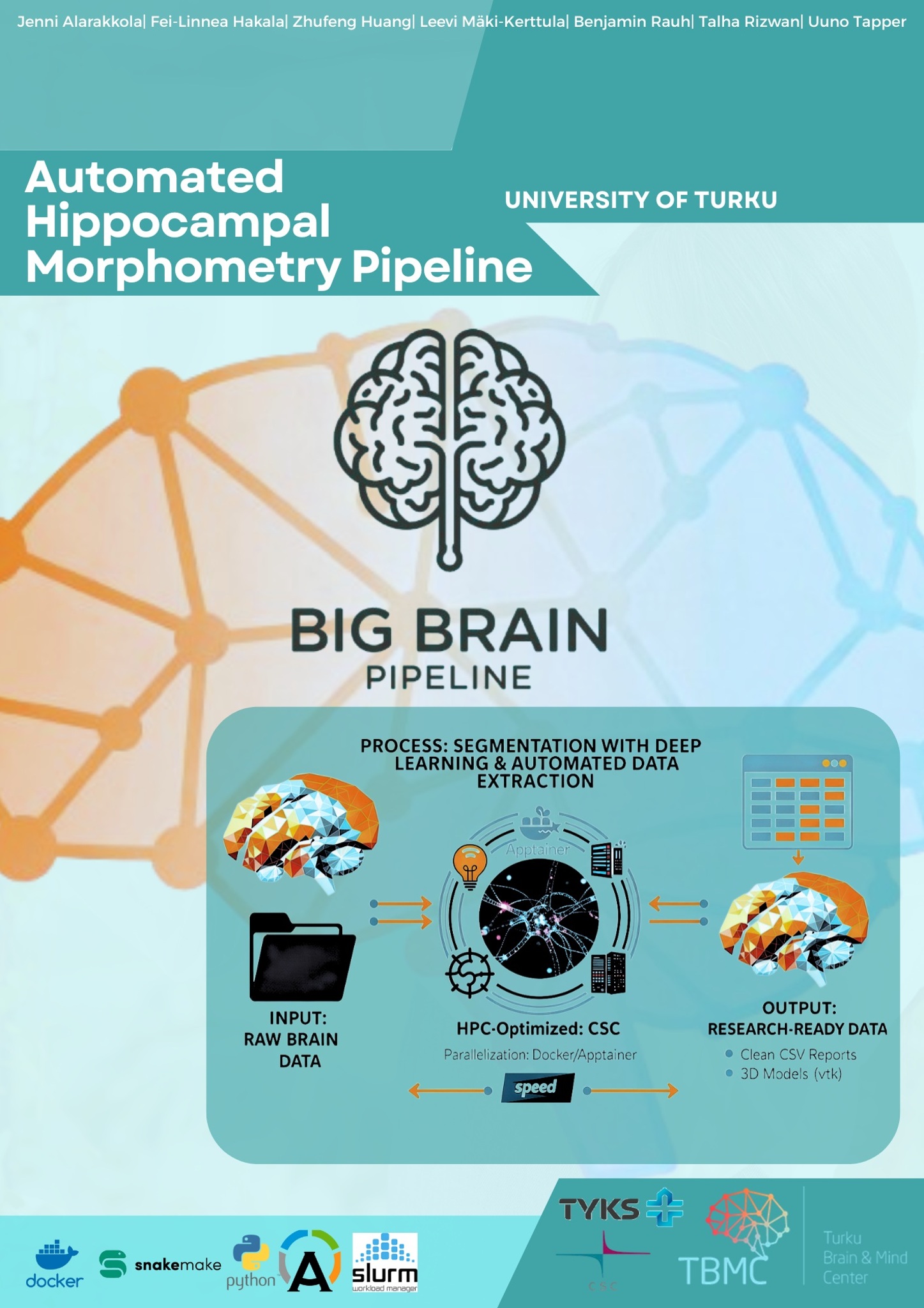
Team Big Brain introduces an automated, high-performance computing pipeline designed for Turku Brain Bank. By leveraging deep learning and CSC’s supercomputing infrastructure, the tool segments the hippocampus into 12 regions from raw MRI scans in under 10 minutes per subject. Featuring a checkpoint system that restarts in case of failure and standardized CSV outputs, the pipeline transforms massive medical datasets into research-ready radiomic features that will be used by the researchers.
The core of our solution is the integration of Deep Learning (HSF) with robust workflow management (Snakemake). The pipeline specifically targets the hippocampus, segmenting it into 12 distinct anatomical subregions (such as DG, SUB, and CA1-3) to detect structural biomarkers that are crucial for understanding memory disorders.
Advantages
The pipeline is a fully automated one command solution for the end user. Scalability for use in the Finnish CSC supercomputing environment. The pipeline is contained in an apptainer container, which makes it platform independent. It can be run on a local laptop, a HPC environment such as CSC or TYKS's own specialized environment.
Results
The end result of the project is a pipeline that takes in T1 MRI brain images, and outputs relevant data about the hippocampus in a single .csv sheet, and provides 3D mesh files for visual inspection.
The .csv sheet has each input image's extracted data in a separate row, meaning a dataset of 100 images when given to the pipeline, will result in a .csv sheet with 100 rows. The columns of the .csv sheet provide the image identification data (patient ID and session ID) and the actual extracted data in the following format.
The researchers can then use these extracted features in different ways to detect the biomarkers as explained above.